
The World’s Largest Real Estate Investment Trusts (REITs)
Quick Summary Audio Real estate is widely regarded as an attractive asset class for investors. This is because it offers several benefits like diversification (due to less correlation with stocks), monthly income, and protection from inflation. The latter is known as “inflation h
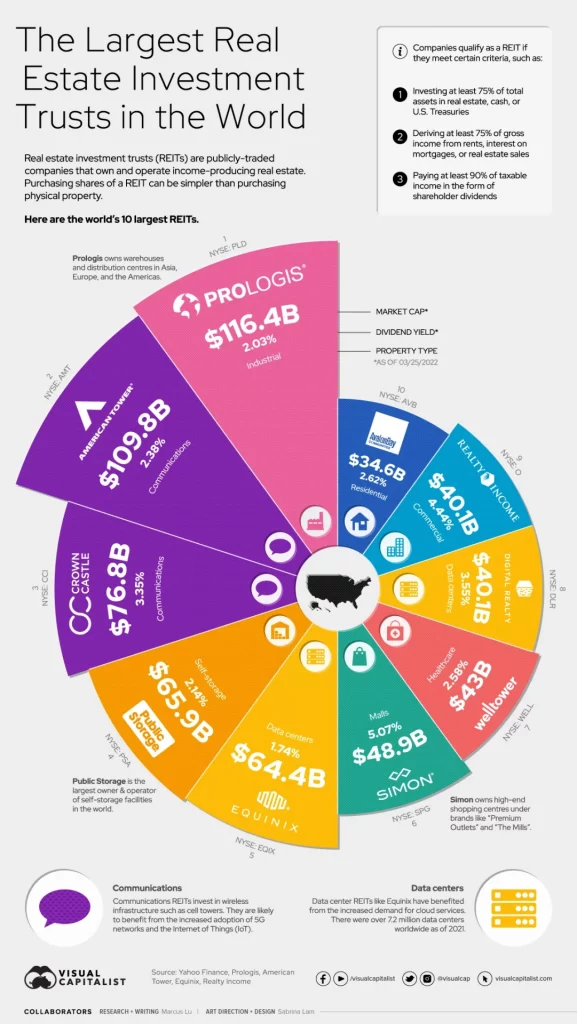
Real estate is widely regarded as an attractive asset class for investors.
This is because it offers several benefits like diversification (due to less correlation with stocks), monthly income, and protection from inflation. The latter is known as “inflation hedging”, and stems from real estate’s tendency to appreciate during periods of rising prices.
Affordability, of course, is a major barrier to investing in most real estate. Property markets around the world have reached bubble territory, making it incredibly difficult for people to get their foot in the door.
Thankfully, there are easier ways of gaining exposure. One of these is purchasing shares in a real estate investment trust (REIT), a type of company that owns and operates income-producing real estate and is most often publicly-traded.
What Qualifies as REIT?
To qualify as a REIT in the U.S., a company must meet several criteria:
- Invest at least 75% of assets in real estate, cash , or U.S. Treasuries
- Derive at least 75% of gross income from rents, interest on mortgages, or real estate sales
- Pay at least 90% of taxable income in the form of shareholder dividends
- Be a taxable corporation
- Be managed by a board of directors or trustees
- Have at least 100 shareholders after one year of operations
- Have no more than half its shares held by five or fewer people
Investing in a REIT is similar to purchasing shares of any other publicly traded company. There are also exchange-traded funds (ETFs) and mutual funds which may hold a basket of REITs. Lastly, note that some REITs are private, meaning they aren’t traded on stock exchanges.
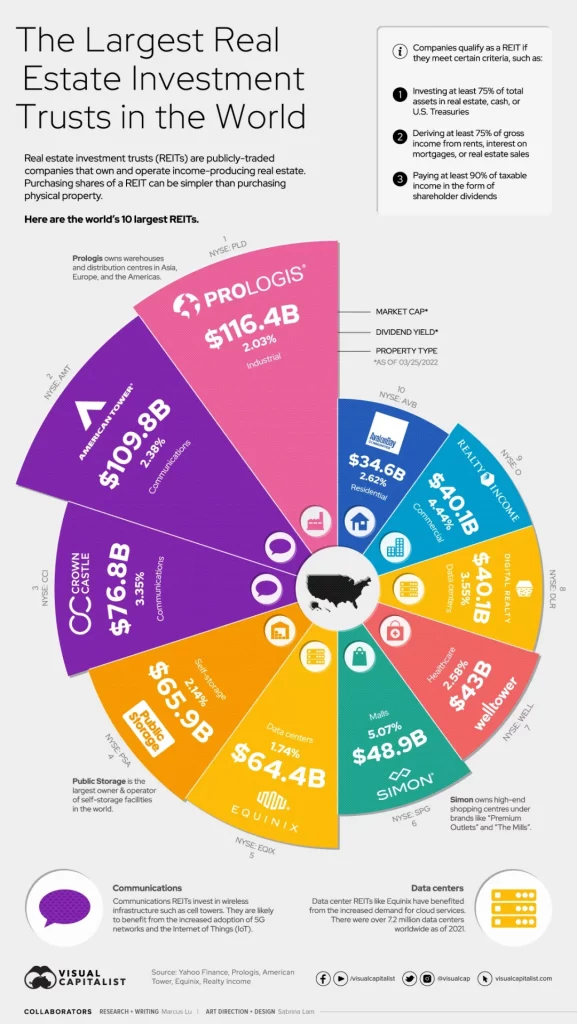
The Top 10 by Market Cap
Here are the world’s 10 largest publicly-traded REITs, as of March 25, 2022.
REIT
Market Cap
Dividend Yield
Property Type
Prologis (NYSE: PLD)
$116.4B
2.03%
Industrial
American Tower (NYSE: AMT)
$109.8B
2.38%
Communications
Crown Castle (NYSE: CCI
$76.8B
3.35%
Communications
Public Storage (NYSE: PSA)
$65.9B
2.14%
Self-storage
Equinix (NYSE: EQIX)
$64.4B
1.74%
Data centers
Simon Property Group (NYSE: SPG)
$48.9B
5.07%
Malls
Welltower (NYSE: WELL)
$43.0B
2.58%
Healthcare
Digital Realty (NYSE: DLR)
$40.1B
3.55%
Data centers
Realty Income (NYSE: O)
$40.1B
4.44%
Commercial
AvalonBay Communities (NYSE: AVB)
$34.6B
2.62%
Residential
As shown above, REITs focus on different sectors of the market. Understanding their differences is an important step to consider before making an investment.
For example, Prologis manages the world’s largest portfolio of logistics real estate. This includes warehouses, distribution centers, and other supply chain facilities around the globe. It’s reasonable to assume that this REIT would benefit from further growth in ecommerce—more on this near the end.
Realty Income, on the other hand, owns a portfolio of over 11,100 commercial real estate properties in the U.S. and Europe. It rents these properties out to major brands like Walgreens and 7-Eleven, which together account for 8.1% of the REIT’s annual income.
More Than Just Buildings
Cell towers and data centers may not seem like “real estate”, but they are both critical pieces of modern infrastructure that take up land.
REITs that focus on these sectors include American Tower and Crown Castle, which own wireless communications assets in the U.S. and abroad. They are likely to benefit from the increased adoption of 5G networks and the Internet of Things (IoT).
On the other hand, Equinix and Digital Realty are focused on data centers, a fast growing industry that is benefitting from digitalization. Both of these REITs work with major tech firms such as Amazon and Google.
Trends to Watch
The demand for real estate can be heavily influenced by overarching trends found around the world. One of these is population growth and urbanization, which has drastically pushed up the cost of housing in many cities around the world.
There’s also the rising prevalence of ecommerce, which has triggered a boom in demand for warehouse space. This is best captured by Amazon’s massive growth during the COVID-19 pandemic, during which the company doubled the number of its warehouse facilities.
Globally, ecommerce accounts for just 19.6% of total retail sales. Should that figure continue to rise, industrial real estate prices could be in store for robust, long-term growth.
More in Real Estate Facts
The World’s Most Populous Countries
Quick Summary Audio The World’s Most Populous Countries (1973–2023) Humankind is now double the size it was in 1973. Of course, that growth has been far from uniform, and the ranking of the world’s most populous countries continues to evolve. Using the latest data available from
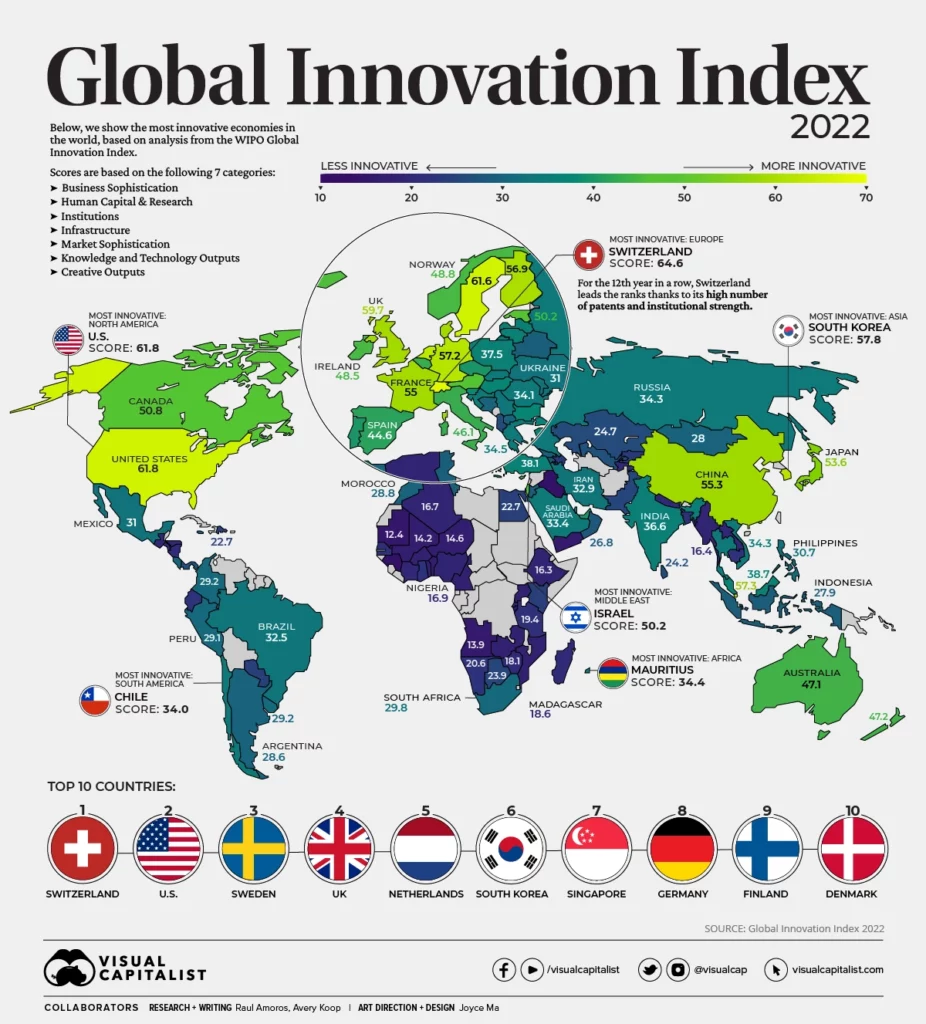
The Most Innovative Countries In The World
Quick Summary Audio Since 2000, global investment in research and development (R&D) has tripled to $2.4 trillion. In 1960, the U.S. made up nearly 70% of global R&D spending, and by 2020 this had fallen to 30%. From job creation and public health to national security and industri
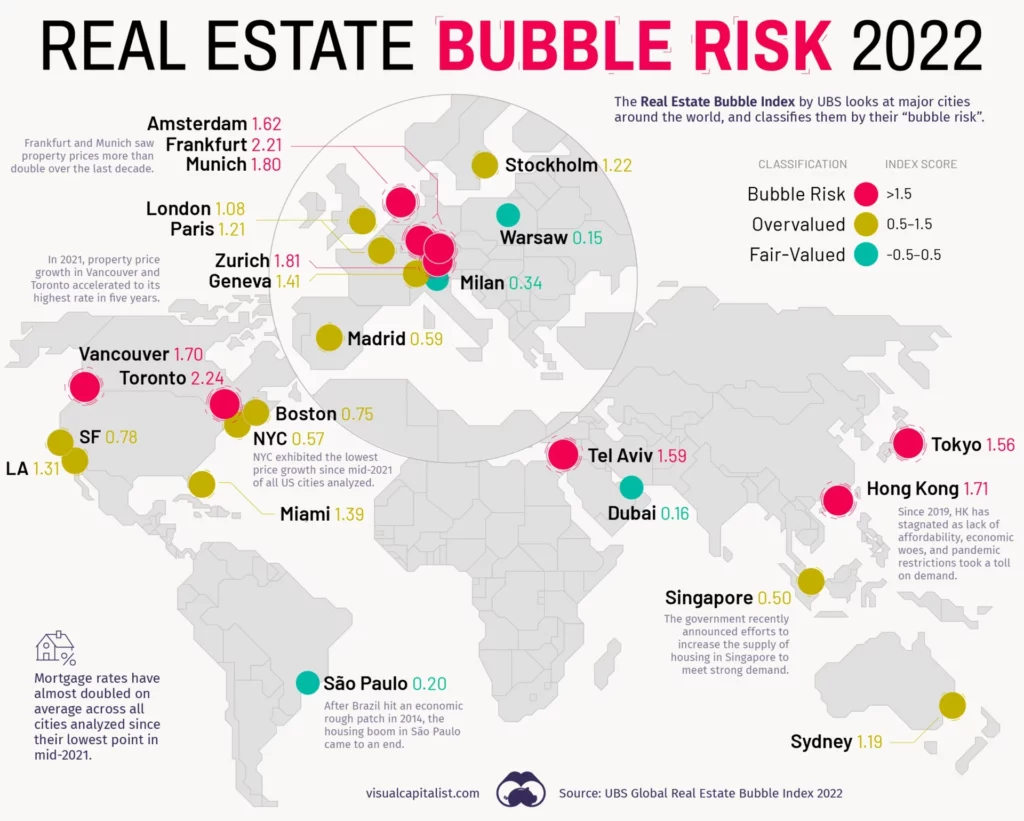
Global Cities With The Highest Real Estate Bubble Risk
Quick Summary Audio Housing bubbles are a tricky phenomenon. As a market gathers steam and prices increase, it remains a matter of debate whether that market is overvalued and flooded with speculation, or it’s simply experiencing robust demand. Of course, once a bubble bursts, it

Ranked: The Most And Least Livable Cities In The World In 2022
Quick Summary Audio Ranked: The Most and Least Livable Cities in 2022 Pandemic restrictions changed the livability of many urban centers worldwide as cultural sites were shuttered, restaurant dining was restricted, and local economies faced the consequences. But as cities worldwi